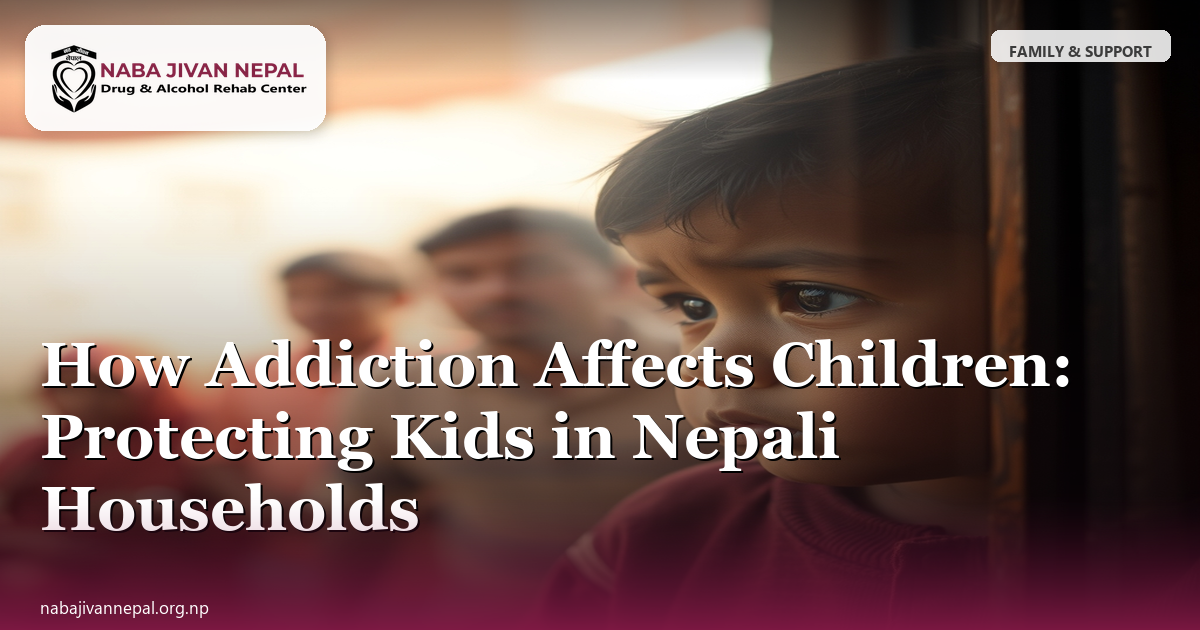
Behind every person struggling with addiction, there is often a child watching, absorbing, and suffering in silence. In Nepal, where family life is central to culture and identity, the addiction effects on children ripple outward in ways that can shape an entire generation. An estimated hundreds of thousands of Nepali children grow up in homes where a parent or caregiver abuses alcohol or drugs — and most of these children receive no support, no explanation, and no protection from the chaos that surrounds them.
This article explores how parental addiction affects children’s development, what behavioral signs indicate a child is being impacted, and how families in Nepal can protect their youngest members while navigating the path to recovery.
How Does a Parent’s Addiction Affect a Child’s Development?
A parent’s addiction disrupts every dimension of a child’s development — emotional, cognitive, social, and physical. Children in addicted households experience chronic stress, inconsistent caregiving, emotional neglect, exposure to conflict or violence, and an unstable home environment that undermines their sense of safety, self-worth, and ability to form healthy relationships throughout their lives.
Emotional Development
- Chronic anxiety: Children live in constant uncertainty — they never know which version of their parent they will come home to. This produces a baseline of anxiety that becomes their “normal.”
- Shame and guilt: Many children blame themselves for their parent’s addiction. “If I were a better child, Baba would not drink.”
- Emotional suppression: Children learn to hide their feelings to avoid triggering the addicted parent or to “keep the peace.”
- Parentification: Older children take on adult responsibilities — cooking, cleaning, caring for younger siblings, managing the household — losing their childhood in the process.
Cognitive Development
- Academic decline: Chronic stress floods the brain with cortisol, impairing concentration, memory, and learning capacity.
- Disrupted routine: Without consistent bedtimes, meals, or study time, academic performance suffers.
- Prenatal exposure: Children exposed to alcohol or drugs in the womb may face lasting cognitive challenges, including Fetal Alcohol Spectrum Disorder.
Social Development
- Trust issues: When the person who should be most reliable is unpredictable, children learn that people cannot be trusted.
- Social isolation: Children may avoid bringing friends home out of shame, leading to loneliness and poor social skills.
- Relationship patterns: Without healthy relationship models, children often replicate dysfunctional patterns in their own adult relationships.
What Behavioral Signs Show a Child Is Affected by Family Addiction?
Children affected by family addiction may exhibit sudden academic decline, withdrawal from social activities, anxiety or fearfulness, aggressive behavior, excessive need to please or be “perfect,” bedwetting or sleep problems, physical complaints without medical cause, hypervigilance (always watching for danger), and age-inappropriate maturity or responsibility-taking.
Children rarely tell adults directly what is happening at home. Instead, their pain comes out through behavior. Watch for:
In Younger Children (Ages 4-10)
- Regression to younger behaviors — bedwetting, thumb-sucking, clinginess
- Nightmares and sleep difficulties
- Unexplained stomachaches or headaches
- Difficulty separating from the non-addicted parent
- Acting out aggressively or becoming unusually quiet
- Difficulty concentrating in school
In Older Children and Teenagers (Ages 11-18)
- Sudden drop in grades
- Withdrawal from friends and activities they once enjoyed
- Anger, defiance, or risk-taking behavior
- Taking on a caretaker role — cooking, cleaning, managing younger siblings
- Perfectionism — trying to control what they can since home feels uncontrollable
- Early substance experimentation themselves (children of addicts are 4-10 times more likely to develop addiction)
- Self-harm or expressions of hopelessness
Teachers, relatives, and community members play a critical role in noticing these signs, as the non-addicted parent may be too overwhelmed to see them clearly.
How Can the Non-Addicted Parent Protect Their Children?
The non-addicted parent can protect children by maintaining as much stability and routine as possible, having honest age-appropriate conversations about what is happening, reassuring children that the addiction is not their fault, shielding them from violence or severe intoxication episodes, seeking support from extended family or community, pursuing family therapy, and establishing clear safety plans for crisis situations.
Immediate Protective Actions
- Name the problem: Children know something is wrong. Age-appropriate honesty (“Baba is sick and needs help for his drinking”) is less damaging than secrecy and confusion.
- Reassure constantly: “This is not your fault. You did nothing wrong. I love you. We are going to be okay.”
- Maintain routine: Consistent meals, bedtimes, school attendance, and activities provide the stability that addiction has stolen from the household.
- Create a safety plan: If the addicted parent becomes violent or severely intoxicated, children should know where to go (a neighbor, relative, or safe room) and who to call.
- Do not use children as messengers: Never ask children to hide alcohol, check on the addicted parent, or relay messages between parents. This places adult burdens on children.
Longer-Term Protection
- Engage extended family: In Nepal’s joint family system, grandparents, aunts, uncles, and older cousins can provide additional stability and emotional support.
- Seek professional help: A counselor experienced with children of addicts can provide age-appropriate therapy that helps process fear, anger, and confusion.
- Address your own wellbeing: You cannot protect your children if you are depleted. Seek support for yourself — through counseling, support groups, or trusted friends.
What Long-Term Effects Do Children of Addicts Face?
Children who grow up with addicted parents face elevated lifelong risks including developing substance addictions themselves (4-10 times higher risk), anxiety and depression, difficulty maintaining healthy relationships, codependency patterns, post-traumatic stress disorder, lower educational attainment, and chronic health problems linked to childhood stress — though these outcomes are not inevitable with proper support.
The Adverse Childhood Experiences (ACE) study — one of the largest public health studies ever conducted — demonstrated that growing up with a substance-abusing parent is a significant adverse childhood experience that correlates with:
- Mental health challenges: Adults who grew up with addicted parents have 2-3 times higher rates of depression, anxiety, and PTSD.
- Addiction risk: Genetic vulnerability combined with learned behavioral patterns makes these children significantly more likely to develop their own addictions.
- Relationship difficulties: Trust issues, fear of abandonment, and codependent patterns established in childhood carry into adult relationships.
- Physical health: Chronic childhood stress affects the immune system, cardiovascular system, and inflammatory responses, increasing adult risk for heart disease, diabetes, and autoimmune conditions.
However — and this is crucial — these outcomes are not destiny. Research consistently shows that even one stable, caring adult relationship can significantly buffer a child against the impacts of parental addiction. Intervention, therapy, and support can redirect a child’s trajectory.
Where Can Families in Nepal Find Support for Children Affected by Addiction?
Support for children affected by addiction in Nepal is available through rehabilitation centers that offer family programs (like Naba Jivan Nepal), child welfare organizations such as CWIN and Maiti Nepal, hospital-based child psychiatry departments, school counselors where available, community-based support groups, and NGOs providing mental health services for children and families.
- Naba Jivan Nepal: Our family therapy program addresses the impact of addiction on every family member, including children. We help parents rebuild healthy family dynamics during and after treatment.
- Hospital services: Kanti Children’s Hospital, TUTH, and Patan Hospital offer child psychiatry and counseling services.
- Child welfare organizations: CWIN (Child Workers in Nepal) and similar organizations provide support for children in crisis situations.
- School-based support: Some schools in Nepal’s larger cities have counselors who can provide basic support. If your child’s school has this resource, inform the counselor of the family situation.
- Support groups: Al-Anon and Alateen (for teenage children of alcoholics) provide peer support. Meetings are available in Kathmandu and are expanding to other cities.
Taking the First Step Toward Recovery
If addiction is affecting your family and your children are caught in the crossfire, please know that seeking help is the bravest thing you can do — not just for yourself or the addicted person, but for the children who are watching and learning from every choice you make.
At Naba Jivan Nepal, we treat addiction as a family condition — because that is what it is. Our programs include family therapy that specifically addresses the needs of children, helping them process what they have experienced and begin healing alongside their parents.
Your children are resilient. But they should not have to be.
Contact Naba Jivan Nepal for family-centered addiction treatment →
Frequently Asked Questions
Should I tell my children about their parent’s addiction?
Yes, in an age-appropriate way. Children already know something is wrong — silence creates confusion and shame. For young children: “Baba is sick and needs special help to get better.” For older children: “Your father has a disease called addiction that makes him dependent on alcohol. It is not his fault or yours, and he is getting help.” Honesty, framed with reassurance, is always better than secrecy.
Will my children automatically become addicts because their parent is one?
No. While children of addicts have a higher genetic and environmental risk (4-10 times more likely), addiction is not automatic. Protective factors — including a stable relationship with at least one caring adult, early education about addiction risks, healthy coping skills, therapy when needed, and a supportive community — significantly reduce the risk. Awareness of the vulnerability is itself a protective factor.
At what age should I start talking to my children about drugs?
Begin age-appropriate conversations as early as age 5-6, focusing on the concept of substances that can be harmful. By ages 8-10, you can introduce more specific information about alcohol and drugs. By the teenage years, conversations should be direct and factual. Children who receive open, honest education from their parents are significantly less likely to develop substance problems than those who receive no guidance.
Should I leave my addicted spouse to protect my children?
This is a deeply personal decision that depends on the specific situation. If there is physical violence or the children are in immediate danger, separation may be necessary for safety. If the addicted spouse is willing to seek treatment, remaining together while establishing clear boundaries and seeking professional help is often preferable. A counselor can help you evaluate your specific situation and make the decision that best protects your children’s wellbeing.
Can children heal from the effects of growing up with an addicted parent?
Yes. With appropriate support, children can heal and thrive. Therapy — particularly play therapy for younger children and cognitive behavioral therapy for older children — helps them process their experiences. Stable, consistent care from at least one parent or caregiver provides the foundation for resilience. The sooner children receive support, the better their outcomes. Healing is a process, not an event, and it requires patience and consistency.